

Everything You Need to Know About Watch Water Resistance — Explained Simply
Everything You Need to Know About Watch Water Resistance — Explained Simply
Water resistance is one of the most misunderstood features in watches. Many people assume that if a watch is labeled “water resistant,” it can safely be worn for swimming or diving. Unfortunately, that is not always the case.
In this guide, we will clearly explain what water resistance ratings actually mean, how they are tested, and what you can safely do with your watch in everyday life.
What does “water resistant” actually mean?
When a watch is labeled as water resistant, it means the case has been designed to withstand exposure to water under specific test conditions. These tests are normally performed in a controlled laboratory environment with stationary water pressure.
This is important because:
- Real-life conditions (such as swimming or jumping into water) can create much higher pressure than the test environment.
- Water resistance is not permanent and can weaken over time.
So the printed rating is a guideline — not an unlimited guarantee.
Understanding water resistance ratings
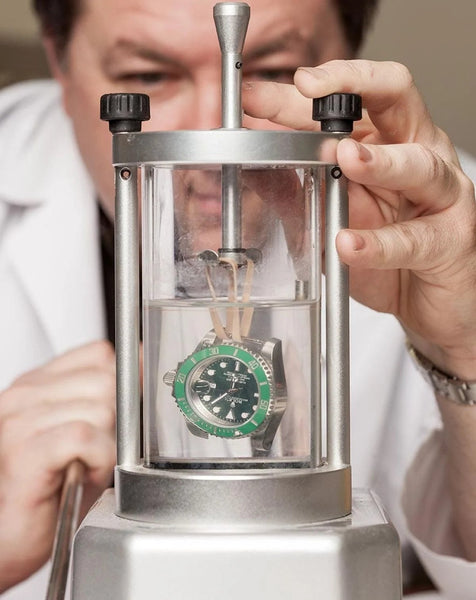
Water resistance is usually expressed in meters (m), ATM (atmospheres), or bar. These units all refer to pressure. For practical purposes:
-
1 ATM = 10 meters = 1 bar
However, the number of meters does not mean the watch can be taken to that depth. It only represents the pressure it was tested to withstand.
Here is a simple breakdown of what each rating generally means in daily use.
30m / 3 ATM — Splash resistant
Suitable for:
- Light rain
- Hand washing
Not suitable for:
- Swimming
- Showering
- Submersion
This level protects against accidental splashes only.
50m / 5 ATM — Light water exposure
Suitable for:
- Showering (without hot water)
- Brief swimming in shallow water
Not suitable for:
- Snorkeling
- Diving
This rating allows brief and gentle submersion.
100m / 10 ATM — Swimming and snorkeling
Suitable for:
- Swimming
- Snorkeling
- Water sports
Not suitable for:
- Scuba diving
This is generally considered safe for most recreational water use.
200m / 20 ATM — Professional-grade water resistance
Suitable for:
- Serious water sports
- Scuba diving
Watches at this level are typically designed with reinforced gaskets and screw-down crowns to ensure sealing.
Why “shock” and movement matter
Movement in water increases pressure on the seals. For example:
- Jumping in a pool
- Rapid arm movement
- Strong water jets
These can exert more force than the static pressure measured in lab testing. That is why some watches technically rated for swimming may still be at risk during intense activity.
The role of seals and gaskets
 Water resistance depends on:
- Case construction
- Crown design
- Gaskets (rubber seals)
Over time, these components can:
- Dry out
- Crack
- Wear down
This means water resistance is not permanent and should be tested periodically if the watch is regularly exposed to water.
Screw-down crowns vs push-pull crowns
A screw-down crown locks the crown into the case to help prevent water from entering. These are typically found on dive watches and provide a higher level of sealing.
Push-pull crowns are more convenient but offer less resistance to moisture entering through the stem.
Avoid hot water and steam
Even on highly water-resistant watches, hot water and steam can cause problems because heat expands materials and weakens seals. It is best to remove your watch before:
- Hot showers
- Saunas
- Jacuzzis
Water resistance and watch modifications
If a watch has been modified:
- Case parts may differ
- Seals may have been disturbed
- Tolerances may change
Because of this, a modified watch should only be considered water-resistant if it has been pressure-tested afterward. At TimeLab Mods, custom builds are handled with this in mind to preserve durability wherever possible.
How to protect your watch
A few simple habits help maintain water resistance:
- Ensure the crown is fully secured
- Avoid operating the crown underwater
- Service gaskets when needed
- Rinse with fresh water after salt exposure
These precautions greatly extend the life of your watch.
Summary table: what each rating really means
| Rating | Everyday Rain | Shower | Swimming | Snorkeling | Diving |
|---|---|---|---|---|---|
| 30m / 3 ATM | Yes | No | No | No | No |
| 50m / 5 ATM | Yes | Yes | Light | No | No |
| 100m / 10 ATM | Yes | Yes | Yes | Yes | No |
| 200m / 20 ATM | Yes | Yes | Yes | Yes | Yes |
(Assuming proper seals and testing)
Final thoughts
Water resistance is not a simple depth rating. It is a measure of controlled pressure, influenced by case design, seals, temperature, and wear over time. Understanding these ratings helps you confidently choose — and protect — the right watch for your lifestyle.
If you are considering a custom-built watch, or simply want to better understand your current timepiece, knowing how water resistance works is one of the most important parts of ownership.
For any questions about our builds or specifications, you are always welcome to reach out to the team at TimeLab Mods.